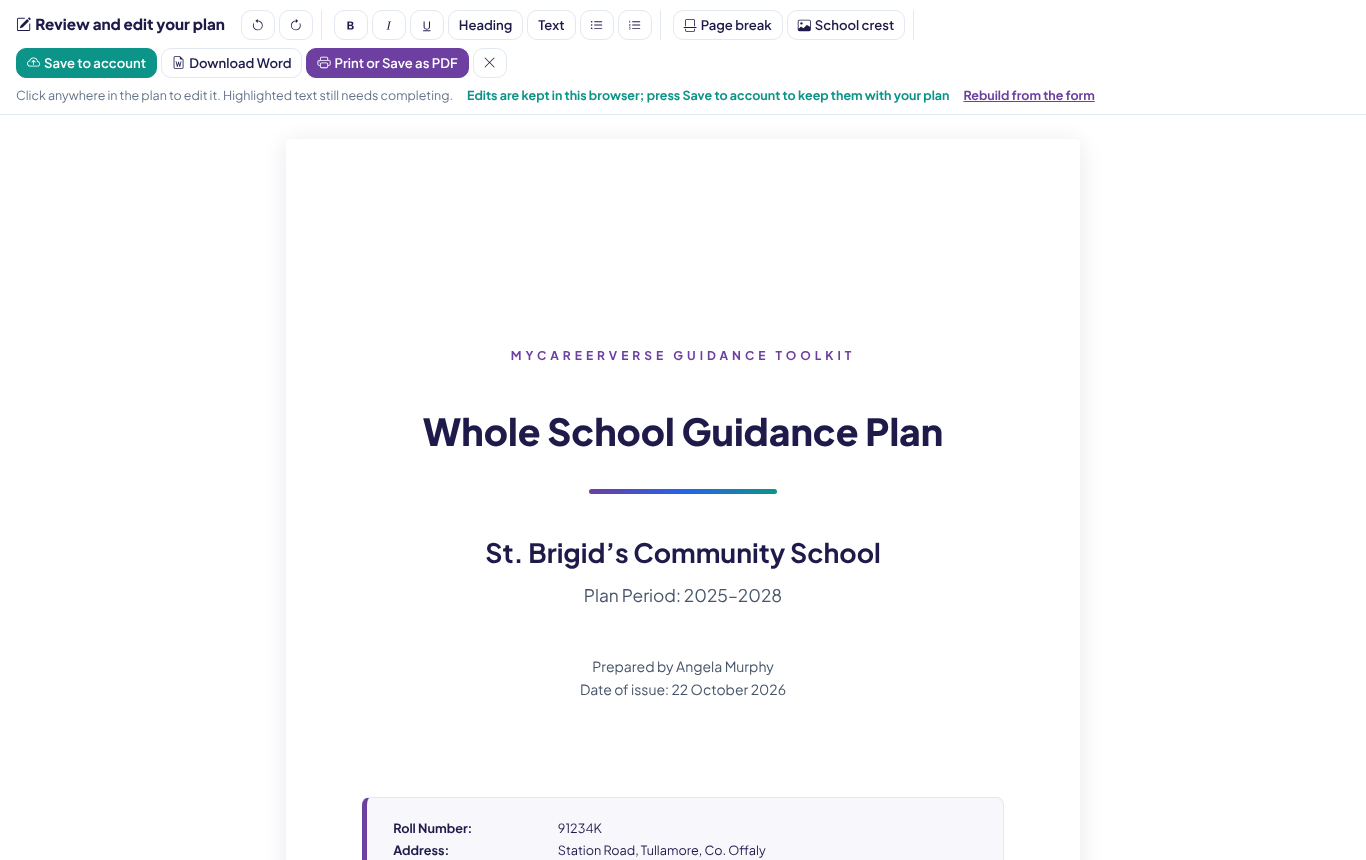
Whole School Guidance Plan

Statutory Basis
Education Act 1998, Section 9(c)
Whole-School Activity
Years 1-6, All Staff Involved
Three Key Strands
Personal, Educational, Career

Introduction & Rationale

Under the Education Act (1998), Section 9(c), post-primary schools in Ireland must use available resources to ensure students have access to appropriate guidance. This Whole-School Guidance Plan provides a comprehensive framework that integrates guidance across all programmes and year groups.

Three Interlinked Strands of Guidance
Personal & Social Development

Self-awareness, relationships, wellbeing, resilience

Educational Guidance

Subject choice, study skills, transitions, pathways

Career & Vocational Guidance

Career exploration, work experience, labour market info

Continuum of Support Model

The continuum of support model (All / Some / Few) helps differentiate guidance provision based on student needs.

Level Students Interventions & Support
ALL Students Universal provision for entire student body
  • Guidance classroom lessons
  • Assembly talks on careers
  • Subject choice information evenings
  • Career guidance library/resources
  • Online career platforms access
SOME Students Targeted support for identified groups
  • Small group workshops (study skills, CAO)
  • Psychometric testing
  • Subject change consultations
  • Work experience mentoring
  • College visit preparation
FEW Students Intensive individual support for complex needs
  • One-to-one counselling sessions
  • Multi-agency case conferences
  • Crisis intervention
  • Tailored pathway planning
  • External specialist referrals

Roles & Responsibilities

  • Ensure the school complies with statutory obligations under Education Act 1998
  • Approve and adopt the Whole-School Guidance Plan
  • Allocate appropriate resources and staffing for guidance provision
  • Monitor implementation and review effectiveness annually
  • Ensure guidance policies align with school ethos and mission

  • Lead the development and implementation of the guidance plan
  • Facilitate staff training and professional development in guidance
  • Timetable guidance allocation hours effectively (counselling, lessons, events)
  • Coordinate whole-school approach across departments
  • Liaise with external agencies and stakeholders
  • Address complaints or concerns about guidance provision

  • Deliver guidance across three strands (personal/social, educational, career)
  • Provide one-to-one counselling for students with specific needs
  • Deliver classroom guidance lessons and small group workshops
  • Administer and interpret psychometric assessments
  • Organize career talks, college visits, work experience programmes
  • Maintain confidential student records in compliance with GDPR
  • Coordinate subject choice processes and CAO applications
  • Liaise with parents, external agencies (NEPS, CAMHS, SOLAS)

  • Integrate guidance elements into subject teaching where appropriate
  • Provide educational guidance on subject options and pathways
  • Monitor student progress and wellbeing, refer concerns to guidance counsellor
  • Support students in developing study skills and exam preparation
  • Collaborate with guidance team on student support cases
  • Participate in guidance-related staff development

Students should:
  • Engage actively with guidance provision (lessons, appointments, events)
  • Take responsibility for their own learning and career planning
  • Seek support when needed and respect confidentiality
  • Provide feedback on guidance services
Parents/Guardians should:
  • Support their child's educational and career development
  • Attend information evenings and parent-teacher meetings
  • Communicate with guidance counsellor when concerns arise
  • Respect school policies regarding confidentiality and data protection

Implementation Action Plan

Term 1: Planning
  • Review and update guidance plan
  • Schedule guidance allocation hours
  • Plan subject choice evenings
  • Book external speakers/workshops
  • Audit guidance resources
Term 2: Delivery
  • Deliver guidance lessons across year groups
  • Conduct psychometric testing
  • Host career events and college visits
  • Complete CAO workshops for 6th years
  • Subject choice consultations
Term 3: Review
  • Evaluate guidance programme effectiveness
  • Gather student/parent feedback
  • Review data and outcomes
  • Plan improvements for next year
  • Report to Board of Management

Guidance Allocation Hours

Schools receive a guidance allocation based on PTR adjustments. The following is a recommended distribution model to balance counselling, classroom work, and career activities.

Activity Type Recommended % Hours (Example: 20hr allocation) Examples
One-to-One Counselling 30-40% 6-8 hours Individual appointments, crisis support, personalized planning
Classroom Lessons 25-35% 5-7 hours Guidance modules, study skills, subject choice talks
Small Group Work 15-20% 3-4 hours CAO workshops, interview skills, career exploration groups
Career Events & Admin 15-20% 3-4 hours Higher options, work experience coordination, record-keeping

Templates & Resources

Student Referral Form

Use this template when referring a student to the guidance counsellor.

Student Name: _________________
Year Group: _________________
Referred By: _________________
Date: _________________
Reason for Referral:
☐ Academic concerns ☐ Career guidance ☐ Personal/social ☐ Subject choice ☐ Other
Details: ____________________
Annual Review Checklist

Complete this checklist at end of school year to evaluate guidance provision.

  • Student feedback surveys collected and analyzed
  • Parent feedback gathered
  • Guidance hours allocation reviewed
  • Subject choice outcomes evaluated
  • CAO/college progression data reviewed
  • Staff training needs identified
  • Plan updated for next academic year
  • Report submitted to Board of Management
Student Self-Assessment Survey

Help students reflect on their guidance needs and experiences.

Sample Questions:
  1. How confident do you feel about your subject choices?
  2. Do you know where to access career information?
  3. Have you had opportunities to explore career options?
  4. What additional guidance support would help you?
Guidance Meeting Calendar

Suggested annual schedule of guidance-related meetings and events.

September: Subject choice info (1st, 2nd, 5th years)
October: CAO workshop kick-off (6th year)
January: Higher Options / College Open Days
March: Work experience preparation (TY)
May: Exam preparation & wellbeing support
June: Annual review & planning meeting

Policies & Procedures

Confidentiality

All guidance interactions are confidential except where disclosure is required by law (child protection concerns, risk of harm). Students and parents will be informed of confidentiality limits at the start of guidance relationships.

Data Protection (GDPR)

Student guidance records are securely stored, accessible only to authorized personnel. Data retention follows school policy and legal requirements. Students/parents have the right to access records upon request.

Subject Choice Changes

Students may request subject changes within the first 4 weeks of academic year. All change requests require consultation with guidance counsellor, parent consent, and approval from subject teacher and principal.

Child Safeguarding

Guidance staff are mandated persons under Children First Act 2015. Any child protection concerns arising in guidance contexts will be reported to the Designated Liaison Person in accordance with school child safeguarding policy.

Monitoring, Review & Evaluation

Regular monitoring ensures the guidance plan remains effective and responsive to student needs. The following evaluation methods are recommended:

Student Surveys

Termly feedback on guidance services

Outcome Data

CAO, PLC, apprenticeship progression

Parent Feedback

Annual consultation evenings

Staff Review

End-of-year evaluation meeting

Key Performance Indicators (KPIs)
  • Percentage of students receiving individual guidance appointments
  • Student satisfaction ratings with guidance services
  • Completion rates for guidance programmes (e.g., CAO workshops)
  • Subject retention rates following initial choices
  • Post-school progression outcomes (higher education, employment, training)
  • Parent attendance at guidance information evenings
  • Staff engagement with whole-school guidance activities
Annual Review Process
  1. Data Collection (May/June): Gather all evaluation data, feedback, and outcomes
  2. Analysis (June): Guidance team reviews data against KPIs and identifies trends
  3. Staff Consultation (June): Present findings to full staff, gather input
  4. Plan Revision (August): Update guidance plan based on evaluation findings
  5. Board Approval (September): Submit revised plan to Board of Management
  6. Communication (September): Share updated plan with students, parents, staff

External Links & Resources

Department of Education

Official guidance policies, circulars, and frameworks

Visit Website
SOLAS

Further education, training, and apprenticeships

Visit Website
PDST

Professional development and guidance resources

Visit Website
CAO

Central Applications Office for higher education

Visit Website
Qualifax

National learners' database and course finder

Visit Website
IGC

Institute of Guidance Counsellors professional body

Visit Website